Is the Maono Pd300X Microphone Still Good in 2026? Long-Term Review
I've been using the Maono Pd300X for several months as my main microphone for podcasting, livestreaming, and some ad-hoc voiceover work. I bought it because the dual USB-C/XLR design promised the flexibility of plug-and-play digital recording with the option to move into an analog setup later. After extended daily use in real project situations, I wanted to write up a detailed, honest account of what it's like to live with the Pd300X in 2026: what I appreciated, what irritated me, and where it still makes sense versus when it doesn't.
Quick summary — my bottom line
In my experience, the Pd300X remains an excellent value for creators who want one mic that can do both USB and XLR without sacrificing too much in sound quality. It’s built like a budget-pro dynamic mic: solid metal body, effective cardioid pattern, and useful onboard DSP when you need it. However, it isn't a magic bullet — the onboard processing can sound artificial if overused, and the microphone still needs proper gain and placement to sing. If you’re aiming for studio-grade vocal warmth and have the budget for high-end preamps, there are better long-term upgrades. For most podcasters, streamers, and content creators in 2026, it’s still a strongly recommended, practical choice.
What I tested and for how long
I used the Pd300X for about eight months across multiple setups: daily livestreams (2–3 hours), recorded podcast episodes (60–90 minutes), and short-form voiceover work. I used it both as a USB-C direct-to-computer microphone and as an XLR-connected mic into a small audio interface. I also tested the Maono Link software DSP presets, the hardware knob and monitoring, and the included accessories (cable, adapter, and shock mount/adapter that came with my unit).
Specifications & what that meant in practice
Here are the key specs that matter to me and how they translated into real use:
- Connection: Dual outputs — USB-C (digital) and XLR (analog). In practice, the USB-C option made setup effortless on my laptop for livestreams, while XLR let me plug into a better preamp when I wanted a warmer, less-processed tone.
- Polar pattern: Cardioid. The pattern does exactly what a cardioid should: it focuses on the voice in front and rejects much of the room. I still needed to position the mic close (2–4 inches) to get the best signal-to-noise ratio.
- Resolution: Up to 192 kHz / 24-bit advertised. In daily spoken-word work I couldn’t reliably tell the difference between 48/24 and 192/24 — the higher rate is nice on paper but not a real-world game changer for voice.
- Frequency response: Around 40 Hz – 16 kHz in the specs. The mic captures voice clearly with enough presence for intelligibility; lows are controlled (less rumble than some condensers), and the highs are present without being overly sibilant.
- Onboard features: Maono Link DSP: limiter, compressor, EQ presets, and noise reduction toggles. The hardware knob gives mic gain/headphone volume control, plus a mute button and 3.5mm latency-free monitoring. Those features are genuinely useful when streaming live.
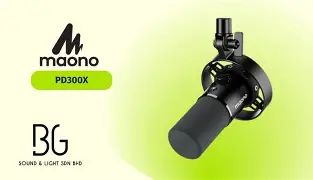
- Accessories: My unit shipped with the USB-C cable, a 5/8" to 3/8" adapter for stands, and a basic shock mount. No dedicated heavy metal desk stand was included (my bundle had the shock mount pre-attached).
Real-world sound — USB vs XLR
One of the Pd300X's best practical strengths is the ability to easily compare the two signal paths. I ran the same spoken passages into the Pd300X via USB-C straight into my laptop and via XLR into a small interface with a clean preamp.
What I found was predictable but important: the XLR path into a good preamp gave me a slightly warmer, more natural vocal — subtle, but noticeable when listening critically on headphones. The USB path sounded a bit cleaner/leaner and benefited from the Maono Link processing if I wanted a ready-made broadcast tone. If you want a dry, raw capture for later processing, XLR is still the better route; if you want fast, consistent results for live streaming, USB works wonderfully well.
Noise floor & gain
The Pd300X is a dynamic mic, and it behaves like one: it has a low noise floor relative to many USB condensers when positioned close. On USB I rarely needed to push the gain to extremes; on XLR you will need preamp gain — exactly like with most dynamic mics — so make sure your interface provides enough clean gain if you plan to use the XLR path exclusively.
Looking for the best Audio & Headphones deals on Amazon?
View Offers →Plosives & proximity effect
I noticed a proximity effect (more bass when the mouth is very close), which can be musical if tamed, but plosives are still a concern when speaking directly into the grille. The included foam windscreen helps a lot for spoken content; I still use an external pop shield for very close-mic voiceover work.
Build quality, controls, and ergonomics
The Pd300X feels solid in the hand — mostly metal construction with a matte finish that stands up to daily use. The threads for stands and boom arms are standard and robust. The hardware knob is well-located and intuitive: twist for gain/monitor volume, press/mute for quick silence, and a secondary function to toggle noise reduction presets.
Two small annoyances I encountered over months of use:
- The plastic trim around the gain knob feels a little lightweight compared with the metal body. It works fine, but it doesn't feel as premium as some higher-end competitors.
- The mute button is slightly recessed; in a live panic I fumbled for it once. It’s not a design failure, just something I learned to practice with.
Maono Link software — helpful but occasionally finicky
The Maono Link app gives access to the onboard DSP: compressors, EQ, and noise reduction. When it works, it’s a great convenience — I could apply a mild compressor and a broadcast EQ to get a ready-to-stream sound within minutes. For livestreams that’s a real time-saver.
That said, my experience included two quirks I want to call out from long-term use:
- I experienced occasional glitches in the app when switching sample rates or changing USB ports. Restarting the app or re-plugging the mic fixed it; firmware and app updates over my testing period improved stability.
- Overusing the DSP presets can add an unnatural sheen or audible pumping. I ended up using the DSP sparingly: a light compressor, modest EQ, and the noise reduction on the lowest effective setting.
Durability & day-to-day reliability
After daily use the Pd300X still looks and works like new. The finish holds up, the grille has no dents, and the internal connections have been reliable. I had zero hardware failures during my testing, which is reassuring for a microphone in this price class.
Find top-rated Audio & Headphones products at great prices.
View Offers →Pros & Cons
- Pros:
- Flexible dual USB-C and XLR outputs — real convenience for creators who switch setups.
- Solid metal build and professional mounting threads.
- Useful onboard DSP and latency-free headphone monitoring for live use.
- Good voice capture with controlled lows and clear presence.
- Included accessories (cable, adapter, basic shock mount) are practical.
- Plug-and-play on most systems; easy to swap between devices.
- Cons:
- Onboard DSP can sound overly processed if used too aggressively.
- Knob trim feels slightly plasticky compared with the body.
- Some Maono Link app instability early on without updates.
- For high-end studio vocals, it’s not a replacement for a top-tier dynamic such as the SM7B paired with a high-quality preamp.
Comparison table — Pd300X vs a few common alternatives
| Microphone | Connection | Polar Pattern | Best for | Notes |
|---|---|---|---|---|
| Maono Pd300X | USB-C & XLR | Cardioid | Streamers, podcasters who want flexibility | Built-in DSP, monitoring jack, good value for dual-mode use |
| Shure SM58 | XLR | Cardioid | Live vocals, rugged stage use | Legendary durability and sound; needs interface/preamp |
| Rode PodMic | XLR | Cardioid | Podcast booths, broadcasters | Designed for spoken word; good value but XLR-only |
| Audio-Technica ATR2100x | USB & XLR | Cardioid | Entry-level streaming & podcasting | Similar dual-mode convenience; Pd300X offers more DSP and higher sample-rate spec |
| Shure SM7B | XLR | Cardioid | Studio-grade broadcast & voiceover | High-end sound, needs substantial clean gain or a preamp like Cloudlifter |
Buying guide — who should pick the Pd300X in 2026
Here’s how I’d decide whether the Pd300X is right for you, based on the way I used it:
- Pick it if: You want one mic that can go from plug-and-play USB to XLR without buying two separate microphones. If you livestream often and sometimes record into a DAW with a preamp, this flexibility is immensely convenient. The built-in monitoring, knob, and DSP are also valuable for solo creators who need fast setup.
- Consider something else if: You are a studio engineer or voice artist chasing a specific tonal warmth and intend to use high-end preamps and processors. In that case, a dedicated XLR dynamic like the SM7B or a high-quality condenser (in a treated room) will be a better long-term investment.
- What to check before buying: Decide whether you’ll mainly use USB or XLR. If you plan heavy XLR use, confirm your audio interface has enough clean gain. If you will rely on USB and the Maono DSP, check current Maono Link app compatibility with your OS — the software has improved but behavior can vary by platform.
- Accessories to consider: A proper boom arm or desk mount (if not bundled), an external pop filter for very close-mic voiceover, and, for XLR users, a preamp or interface with at least 50–60 dB of clean gain if your voice is low-level.
Long-term notes — maintenance and updates
Over months of use I treated the Pd300X like any other mic: keep it covered when not in use, avoid dropping it, and check firmware/software updates regularly. Maono released firmware and app updates during my testing that improved stability and took away a couple of small odd behaviors. If you buy a Pd300X now, expect the manufacturer to continue providing software maintenance, but don’t expect miracles — the hardware itself is the primary product.
Final thoughts — is it still good in 2026?
Yes — in my experience the Maono Pd300X remains a very relevant and useful microphone in 2026. It’s not the last word in professional studio capture, but it is a highly practical, cost-effective tool that fills multiple roles well. For creators who value flexibility, easy monitoring, and onboard processing, the Pd300X cuts out a lot of friction: fewer cables to swap, quick presets for live streams, and a robust build for daily use.
What I appreciated most was the freedom to switch between USB and XLR without changing mics. The Maono Link DSP gave me consistent vocal tones for live sessions when I wanted them, and the XLR path delivered a warmer, raw sound when I wanted to record and mix later. What I found disappointing at times was the temptation to rely on the DSP — I learned that modest settings preserve natural voice, while aggressive presets make audio sound processed. Also, the small ergonomic niggles (knob feel, recessed mute) are worth noting but not dealbreakers.
Ultimately, if you’re a content creator looking for a single mic that can grow with your setup, the Pd300X is still a solid choice in 2026. It won’t replace a dedicated high-end studio chain, but it will get you sounding good quickly and reliably — and in my experience, that practical usefulness is what matters day-to-day.